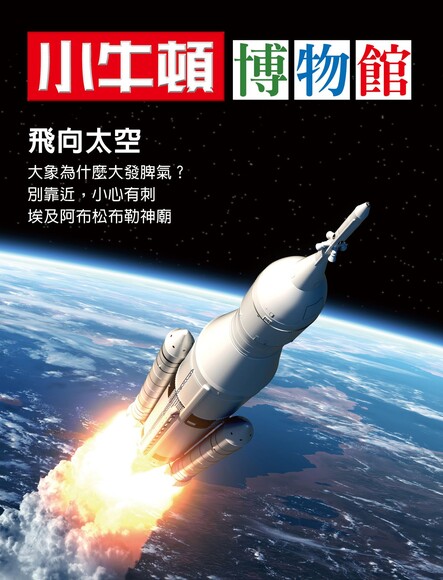
Space exploration captures children’s wonder like nothing else. Yet finding authentic, high-quality aerospace non-fiction in Traditional Chinese can be challenging for overseas families. 《小牛頓博物館:飛向太空》 fills that void with museum-level technical illustrations and accessible physics explanations.

| Chinese Title | 《小牛頓博物館:飛向太空》 |
| English Title | Newton Science: Blasting Off into the Cosmos |
| Author / Creator | 小牛頓科學教育團隊 |
| Publisher | 小牛頓科學教育 |
| Content Age Group | Ages 7–11 (Content Maturity) |
| Motherly Notes Level | Middle Level |
| Word Count / Format | Approx. 5,200 words across 64 pages; detailed rocket schematics, space suits, and planetary charts. |
| Readmoo Rating | ⭐⭐⭐⭐⭐ 5.0 Stars |
🎯 Motherly Notes Reading Level Framework: Why We Separate Age from Chinese Level
At Motherly Notes School, one of our most important rules is: Never judge a child’s Chinese reading level by their chronological age. A 9-year-old might be cognitively ready for complex mystery plots, but if their Chinese literacy is at a beginner level, handing them a 30,000-word novel will crush their confidence. Conversely, an advanced 6-year-old might read chapter books with ease!
This Book’s Level: Middle Level
Aerospace engineering, Apollo missions, and planetary astronomy with full Zhuyin (~800–1,200 characters).
Click to see Motherly Notes 5-Tier Level Reference Guide ▾
\n- \n
- Convo Level: No Chinese reading yet. Early oral bilingual learners (bilingual read-alouds). \n
- Beginner Level: Knows Zhuyin/Pinyin phonetics; reads standard simple picture books (~200–500 sight words). \n
- Lower Level: Knows ~500+ characters by sight + solid Zhuyin/Pinyin decoding. Equivalent to 1st–2nd grade in Asia (native ages up to 8–9). \n
- Middle Level: Knows ~1,000+ characters without phonetic help; reads sustained chapter books (native ages 8–11). \n
- Upper Level: Knows ~2,000+ characters; reads novels without phonetic help (native ages 10–18 / AP Chinese). \n
📖 What the Book Is Actually About
\n\n\n\nThe book traces the history of human spaceflight from the early Chinese gunpowder arrows and the Apollo 11 moon landing to modern Mars rovers and future space colonies. It details how liquid-fuel rocket engines work, why astronauts float in free-fall orbit, and how spacesuits protect against extreme vacuum conditions.
\n\n\n\n💡 Why It’s Great for Bilingual Kids (Pedagogical Wins)
\n\n\n\n1. High-Value STEM Vocabulary: Introduces aerospace terms like 推進器 (thruster), 地球脫離速度 (escape velocity), and 太空站 (space station).
2. Detailed Engineering Schematics: Cross-sections of the Saturn V rocket and Apollo lunar module satisfy detail-obsessed mechanical minds.
3. Inspires Curiosity Beyond Screens: Connects nighttime stargazing with human scientific triumph and engineering courage.
⚠️ Caveats
\n\n\n\n• Sci-Fi fantasy disclaimer: This covers real-world rocket physics and space agency missions, not Star Wars alien battles.
• Dense text panels: Take time to explore the diagrams together.
\n\n\n\n
🚀 How to Access This Book
\n\n\n\nFor overseas families, getting physical Chinese books shipped can take weeks and cost a small fortune in freight. \nReading on Readmoo gives you instant, legitimate digital access—plus crystal-clear typography on your iPad, computer, or mooInk e-reader.
\n\n\n\n\n