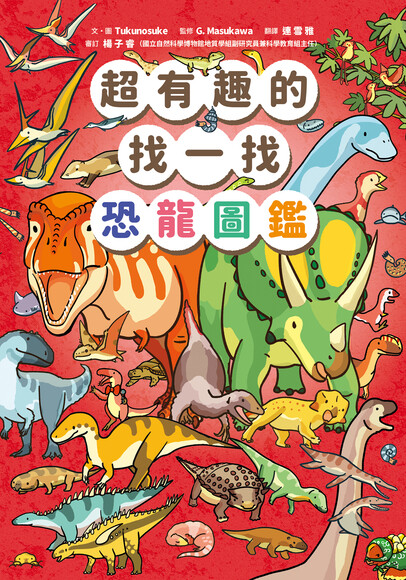
When getting a 5 to 8-year-old to read Chinese feels like a battle of wills, interactive seek-and-find books are a parent’s best weapon. 《超有趣的找一找恐龍圖鑑》 merges the addictive fun of Where’s Waldo with accurate, up-to-date dinosaur paleontology illustrated by Japanese paleo-artist ツク之助.

| Chinese Title | 《超有趣的找一找恐龍圖鑑》 |
| English Title | The Ultimate Search-and-Find Dinosaur Safari |
| Author / Creator | ツク之助(Tukunosuke) |
| Publisher | 小角落文化 |
| Content Age Group | Ages 5–9 (Content Maturity) |
| Motherly Notes Level | Beginner to Lower Level |
| Word Count / Format | Approx. 2,000 words total across 48 large panoramic pages; visual captions and species stat boxes. |
| Readmoo Rating | ⭐⭐⭐⭐⭐ 5.0 Stars |
🎯 Motherly Notes Reading Level Framework: Why We Separate Age from Chinese Level
At Motherly Notes School, one of our most important rules is: Never judge a child’s Chinese reading level by their chronological age. A 9-year-old might be cognitively ready for complex mystery plots, but if their Chinese literacy is at a beginner level, handing them a 30,000-word novel will crush their confidence. Conversely, an advanced 6-year-old might read chapter books with ease!
This Book’s Level: Beginner to Lower Level
Combines Where’s Waldo visual seek-and-find spreads with concise dinosaur fact cards. (~300–500 sight words + full Zhuyin).
Click to see Motherly Notes 5-Tier Level Reference Guide ▾
- Convo Level: No Chinese reading yet. Early oral bilingual learners (bilingual read-alouds).
- Beginner Level: Knows Zhuyin/Pinyin phonetics; reads standard simple picture books (~200–500 sight words).
- Lower Level: Knows ~500+ characters by sight + solid Zhuyin/Pinyin decoding. Equivalent to 1st–2nd grade in Asia (native ages up to 8–9).
- Middle Level: Knows ~1,000+ characters without phonetic help; reads sustained chapter books (native ages 8–11).
- Upper Level: Knows ~2,000+ characters; reads novels without phonetic help (native ages 10–18 / AP Chinese).
📖 What the Book Is Actually About
Readers travel through the Mesozoic era across dense panoramic landscapes—swamps, volcanic valleys, coastal reefs, and redwood forests. Each spread presents visual checklist missions (e.g., ‘Find 5 Stegosaurs hiding in the ferns’ or ‘Spot the Velociraptor hunting a lizard’), paired with bite-sized fact cards explaining their real behaviors.
💡 Why It’s Great for Bilingual Kids (Pedagogical Wins)
1. Builds Intense Visual Focus & Observation: Trains kids to scan details, follow instructions, and notice subtle anatomical differences.
2. Natural Vocabulary Acquisition: Kids learn descriptive spatial prepositions (在岩石後面, 藏在泥巴裡, 浮在水面上) while playing.
3. Accurate Modern Paleontology: Reflects modern feathered dinosaur discoveries rather than outdated 1990s lizard tropes.
⚠️ Caveats
• Not a bedtime story: This book is designed for active daytime engagement. Reading it right before sleep will hype kids up looking for hidden fossils.
• Light on paragraphs: It uses short callouts and labels, so don’t expect sustained narrative paragraphs.
🚀 How to Access This Book
For overseas families, getting physical Chinese books shipped can take weeks and cost a small fortune in freight. \nReading on Readmoo gives you instant, legitimate digital access—plus crystal-clear typography on your iPad, computer, or mooInk e-reader.