
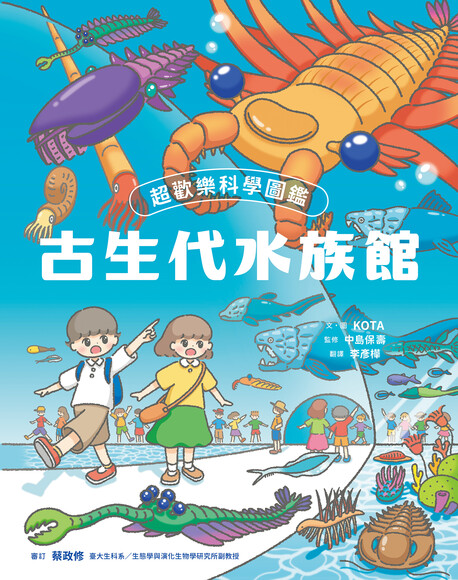
Most kids can name ten different dinosaurs, but ask them about the bizarre prehistoric creatures that swam the oceans 500 million years before T-Rex, and they draw a blank. Japanese science writer Kota created 《古生代水族館:超歡樂科學圖鑑》 to turn Cambrian and Paleozoic paleontology into an irresistible zoo-tour comedy.

| Chinese Title | 《古生代水族館:超歡樂科學圖鑑》 |
| English Title | The Paleozoic Aquarium: Prehistoric Marine Life Made Hilarious |
| Author / Creator | Kota |
| Publisher | 小角落文化 |
| Content Age Group | Ages 7–11 (Content Maturity) |
| Motherly Notes Level | Lower to Middle Level |
| Word Count / Format | Approx. 4,000 words across 80+ full-color pages; modular fish-tank profiles and trivia bubbles. |
| Readmoo Rating | ⭐⭐⭐⭐⭐ 5.0 Stars |
🎯 Motherly Notes Reading Level Framework: Why We Separate Age from Chinese Level
At Motherly Notes School, one of our most important rules is: Never judge a child’s Chinese reading level by their chronological age. A 9-year-old might be cognitively ready for complex mystery plots, but if their Chinese literacy is at a beginner level, handing them a 30,000-word novel will crush their confidence. Conversely, an advanced 6-year-old might read chapter books with ease!
This Book’s Level: Lower to Middle Level
Illustrated guide with full Zhuyin and infographic stat cards. Approachable for kids with ~500–800 characters who love paleontology.
Click to see Motherly Notes 5-Tier Level Reference Guide ▾
- Convo Level: No Chinese reading yet. Early oral bilingual learners (bilingual read-alouds).
- Beginner Level: Knows Zhuyin/Pinyin phonetics; reads standard simple picture books (~200–500 sight words).
- Lower Level: Knows ~500+ characters by sight + solid Zhuyin/Pinyin decoding. Equivalent to 1st–2nd grade in Asia (native ages up to 8–9).
- Middle Level: Knows ~1,000+ characters without phonetic help; reads sustained chapter books (native ages 8–11).
- Upper Level: Knows ~2,000+ characters; reads novels without phonetic help (native ages 10–18 / AP Chinese).
📖 What the Book Is Actually About
The premise is delightfully creative: welcome to a state-of-the-art public aquarium where the exhibits feature real ancient sea life from the Cambrian, Ordovician, and Devonian periods. Tour guides struggle to keep predatory Anomalocaris from eating other exhibits, explain why trilobites keep molting in the filters, and show how early fish developed the first jaws.
💡 Why It’s Great for Bilingual Kids (Pedagogical Wins)
1. Expands Prehistoric Knowledge Beyond Dinosaurs: Introduces evolutionary milestones (the Cambrian Explosion, exoskeleton armor, early marine adaptations).
2. Zero-Fatigue Modular Reading: Perfect for kids who get overwhelmed by continuous text—they can read about one creature profile per sitting.
3. Full Zhuyin Support: Phonetic annotations allow children to decode specialized scientific and creature names independently.
⚠️ Caveats
• Not a storybook narrative: It is structured as an illustrated guidebook/encyclopedia with zookeeper comic strips.
• Some creatures look truly weird: Cambrian fauna have multiple eyes, spiky tentacles, and backwards mouths—nature was wild back then!
🚀 How to Access This Book
For overseas families, getting physical Chinese books shipped can take weeks and cost a small fortune in freight. \nReading on Readmoo gives you instant, legitimate digital access—plus crystal-clear typography on your iPad, computer, or mooInk e-reader.

