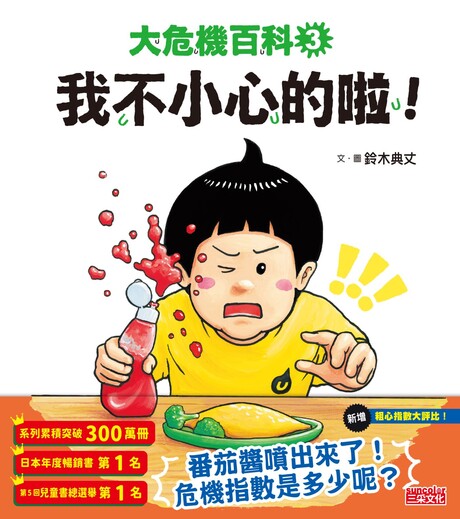
Young children often experience intense meltdown anxiety when they make a mistake. Spilling a glass of milk or tearing a drawing feels like the end of the universe. Master Japanese humorist 鈴木典丈 created 《大危機百科3:我是不小心的啦!》 (Grand Crisis Encyclopedia 3) to give kids the ultimate gift: the ability to laugh at their own blunders and bounce back.

| Chinese Title | 《大危機百科3:我是不小心的啦!》 |
| English Title | Oops, My Bad! Kid-Approved Survival Guide to Everyday Disasters |
| Author / Creator | 鈴木典丈 |
| Publisher | 三采文化 |
| Content Age Group | Ages 5–9 (Content Maturity) |
| Motherly Notes Level | Beginner to Lower Level |
| Word Count / Format | Approx. 2,000 words across 48 panoramic illustrated pages; crisis rating scales and funny escape plans. |
| Readmoo Rating | ⭐⭐⭐⭐⭐ 5.0 Stars |
🎯 Motherly Notes Reading Level Framework: Why We Separate Age from Chinese Level
At Motherly Notes School, one of our most important rules is: Never judge a child’s Chinese reading level by their chronological age. A 9-year-old might be cognitively ready for complex mystery plots, but if their Chinese literacy is at a beginner level, handing them a 30,000-word novel will crush their confidence. Conversely, an advanced 6-year-old might read chapter books with ease!
This Book’s Level: Beginner to Lower Level
Visual infographic comedy manual with full Zhuyin (~300–600 characters). Teaches emotional resilience and crisis recovery.
Click to see Motherly Notes 5-Tier Level Reference Guide ▾
- Convo Level: No Chinese reading yet. Early oral bilingual learners (bilingual read-alouds).
- Beginner Level: Knows Zhuyin/Pinyin phonetics; reads standard simple picture books (~200–500 sight words).
- Lower Level: Knows ~500+ characters by sight + solid Zhuyin/Pinyin decoding. Equivalent to 1st–2nd grade in Asia (native ages up to 8–9).
- Middle Level: Knows ~1,000+ characters without phonetic help; reads sustained chapter books (native ages 8–11).
- Upper Level: Knows ~2,000+ characters; reads novels without phonetic help (native ages 10–18 / AP Chinese).
📖 What the Book Is Actually About
The book catalogs dozens of hyper-relatable childhood disasters: dropping your toast butter-side down, getting your sleeve soaked while washing hands, or shouting the teacher’s name as ‘Mom!’ in front of the whole class. Each crisis is evaluated with pseudo-scientific cross-sections, panic level meters (危機指數), and increasingly absurd ‘countermeasures.’
💡 Why It’s Great for Bilingual Kids (Pedagogical Wins)
1. Cures Perfectionist Meltdowns: Normalizes accidents through explosive visual comedy, reducing performance anxiety in school.
2. Engaging Infographic Format: Reluctant readers love scanning the funny meters, labels, and facial reaction zoom-ins.
3. Teaches Problem Solving & Emotional Grit: Prompts children to pause, breathe, and think: ‘Okay, how do we clean this up?’
⚠️ Caveats
• Not a tranquil bedtime selection: This book will induce loud snorts and belly laughs—read during daytime or weekend family reading.
• Absurd advice warning: The survival strategies are hilarious parodies (e.g. pretending you meant to spill it); remind kids to still apologize in real life!
🚀 How to Access This Book
For overseas families, getting physical Chinese books shipped can take weeks and cost a small fortune in freight. \nReading on Readmoo gives you instant, legitimate digital access—plus crystal-clear typography on your iPad, computer, or mooInk e-reader.

