
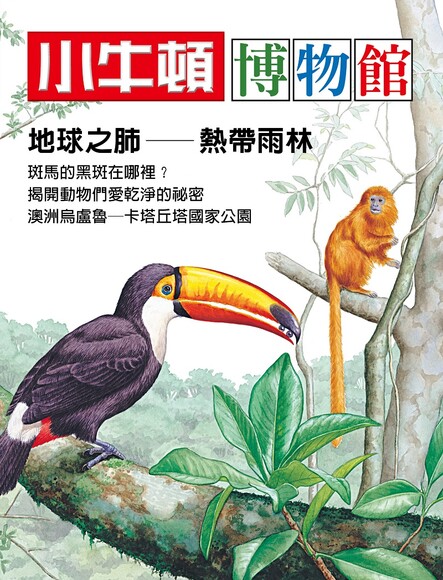
Teaching children about climate change can easily sound abstract or apocalyptic. 《小牛頓博物館:地球之肺熱帶雨林》 takes a vastly more inspiring approach: it instills deep wonder for the staggering biodiversity of the Amazon and Southeast Asian rainforests, showing why these ecosystems are irreplaceable.

| Chinese Title | 《小牛頓博物館:地球之肺熱帶雨林》 |
| English Title | Newton Science: Rainforests, the Living Lungs of Earth |
| Author / Creator | 小牛頓科學教育團隊 |
| Publisher | 小牛頓科學教育 |
| Content Age Group | Ages 7–11 (Content Maturity) |
| Motherly Notes Level | Middle Level |
| Word Count / Format | Approx. 4,800 words across 60 pages; rich vertical canopy cutaways and species spotlights. |
| Readmoo Rating | ⭐⭐⭐⭐⭐ 5.0 Stars |
🎯 Motherly Notes Reading Level Framework: Why We Separate Age from Chinese Level
At Motherly Notes School, one of our most important rules is: Never judge a child’s Chinese reading level by their chronological age. A 9-year-old might be cognitively ready for complex mystery plots, but if their Chinese literacy is at a beginner level, handing them a 30,000-word novel will crush their confidence. Conversely, an advanced 6-year-old might read chapter books with ease!
This Book’s Level: Middle Level
Explores complex ecological webs from forest floor to emergent canopy layers with full Zhuyin (~800–1,200 characters).
Click to see Motherly Notes 5-Tier Level Reference Guide ▾
- Convo Level: No Chinese reading yet. Early oral bilingual learners (bilingual read-alouds).
- Beginner Level: Knows Zhuyin/Pinyin phonetics; reads standard simple picture books (~200–500 sight words).
- Lower Level: Knows ~500+ characters by sight + solid Zhuyin/Pinyin decoding. Equivalent to 1st–2nd grade in Asia (native ages up to 8–9).
- Middle Level: Knows ~1,000+ characters without phonetic help; reads sustained chapter books (native ages 8–11).
- Upper Level: Knows ~2,000+ characters; reads novels without phonetic help (native ages 10–18 / AP Chinese).
📖 What the Book Is Actually About
The book organizes the rainforest into distinct vertical zones: the subterranean roots, the forest floor (森林底層), the understory (灌木層), the canopy (樹冠層), and the emergent layer (露生層). It explores aerial bromeliads holding miniature aquatic ecosystems, army ant swarms, and the indigenous tribes who live in harmony with the jungle.
💡 Why It’s Great for Bilingual Kids (Pedagogical Wins)
1. Teaches Ecological Stratification: Helps children visualize vertical ecological niches and symbiotic adaptations (共生關係).
2. Rich Biological Vocabulary: Expands Chinese terms for plant structures (附生植物, 板根, 氣生根) and ecological cycles (碳循環).
3. Stunning Educational Visuals: Features detailed cross-sections that make complex ecological mechanics immediately intuitive.
⚠️ Caveats
• Dense informational layout: Designed for inquiry and research, not a bedtime nursery rhyme.
• Environmental urgency: Mentions deforestation and illegal logging, which may prompt thoughtful questions about conservation.
🚀 How to Access This Book
For overseas families, getting physical Chinese books shipped can take weeks and cost a small fortune in freight. \nReading on Readmoo gives you instant, legitimate digital access—plus crystal-clear typography on your iPad, computer, or mooInk e-reader.

