Today, I was teaching an essay class and noticed something immediately: a few students had clearly used AI to help them write.
And guess what?
Their essays all had the same wording. The same flow. The same polished-but-empty feeling.
Well, duh. It’s AI.
Of all people, don’t I know it well enough? That was the tough moment for me.
I’ve always been the cool auntie, the big sister type. The students listen to me. They trust me. I’m not just an educator in their eyes. I’m someone safe. Someone who sees them. So how do I suddenly become the person who says, “You can’t use AI”?
Especially when I’m also the Executive Director of INCUBATOR SCHOOL, where we actively teach AI, coding, and responsible innovation.
So the real question is not: How do we ban AI?
The real question is: How do we teach children not to depend on AI for creative work, while still teaching them how to use it wisely?
And beyond that, how do we equip our teachers to teach well in the age of AI, so that students become sharper thinkers, stronger writers, and more creative human beings?
That is the conversation educators need to be having.
The Problem Isn’t AI. It’s Misuse.
AI is not the enemy of learning.
But it can become the enemy of thinking when students use it to skip the messy, essential parts of the process: brainstorming, struggling, organizing thoughts, finding their voice, and learning how to say what they actually mean.
Creative writing is not just about producing a clean final draft. It is about forming ideas. It is about perspective. It is about discovering how your own mind works.
When a student lets AI do the thinking, the student may still submit an essay, but they lose something much bigger: the chance to become a writer.
That’s what we have to protect.
What I Did Instead of Calling Anyone Out
So I started applying the methods of teaching I’ve been using at Incubator School here at Motherly Notes Chinese.
I asked everyone to stop writing.
Then I gave them a completely different prompt on the spot.
No warning. No time to prepare. No time to generate something elsewhere.
We ideated in real time. I asked for participation one by one. We built the structure of each new essay out loud together. And then I watched them type, word for word, what they were verbally saying to me.
Instead of quietly turning in suspiciously polished work, they were suddenly thinking in front of each other.
We discussed.
We brainstormed.
We wrestled with ideas in class.
And what transpired were entirely new essays, written live, without me having to call anyone out.
That mattered.
Because the point was never to shame them.
The point was to bring them back to themselves.
Their Real Voices Came Back
As they wrote on the new prompt, something beautiful happened.
Their writing came alive.
Each essay sounded different. Each student had a different rhythm, a different tone, a different way of seeing the world. Their real voices returned.
And I told them so.
I explained how these new essays had personality. How their style was beautiful. How their voices made the writing worth reading. I told them that no tool or device could ever replicate an author’s true voice.
I reminded them that their thoughts, their brains, and their ideas are so powerful that no AI could ever replace them.
That is what catches a reader’s attention.
That is what makes writing memorable.
Not perfection.
Not polish.
Not robotic fluency.
Voice.
Sometimes the Strongest Lesson Is the One You Don’t Say Out Loud
I never directly said, “I know some of you used AI on the first prompt.”
I didn’t need to.
I think the students who used it realized that I knew.
But there is power in the unsaid.
Sometimes, when a lesson is left unspoken, it lands deeper. The silence becomes the message. The room understands. Everyone knows. And that knowing creates a stronger internal shift than public correction ever could.
That is where real change begins: not in humiliation, but in self-awareness.
At Motherly Notes and Incubator School, self-motivation is at the core of what we do.
The theories we use to educate students are not only built on encouragement, but also on trust, restraint, rapport, and the subtle power of an environment where students feel seen enough to do better on their own.
That is our school culture.
That is who we are.
What Educators Need to Understand About AI
If we want to prepare students for the real world, we cannot pretend AI does not exist.
But we also cannot let it replace the parts of learning that build intelligence, originality, and character.
Students need to be taught that AI can support learning, but it should not replace thinking.
Teachers need training too.
They need to know how to redesign lessons so that students must think in real time. They need to facilitate discussion, verbal ideation, spontaneous writing, and reflection. They need to assess process, not just product.
In the age of AI, teaching has to become more human, not less.
We need classrooms where students speak before they write, think before they generate, and discover that the most valuable thing they bring to the page is themselves.
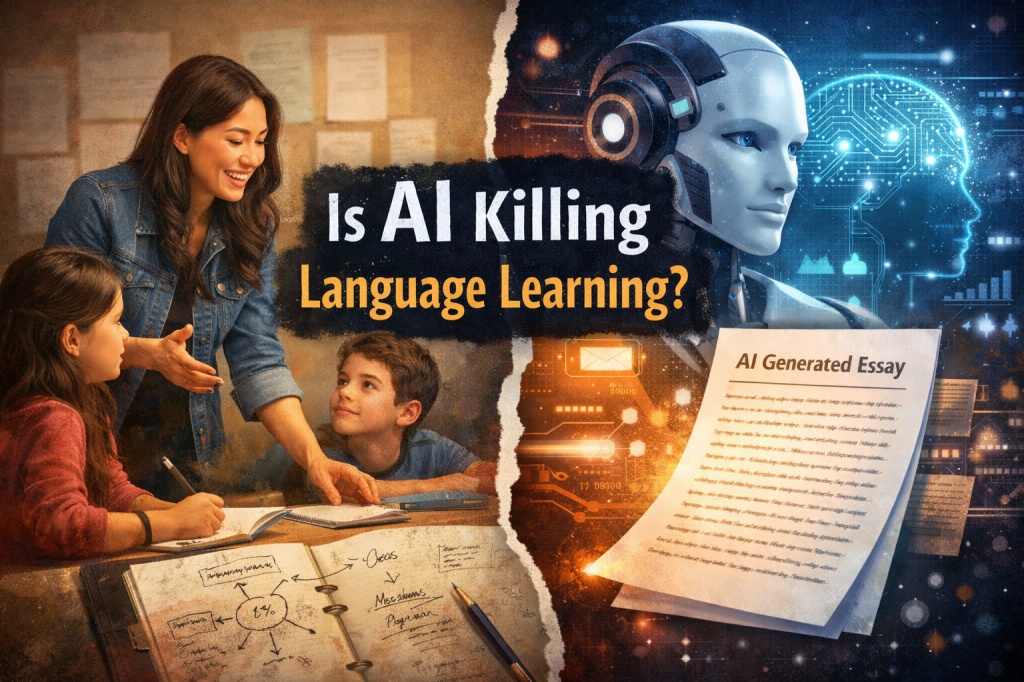
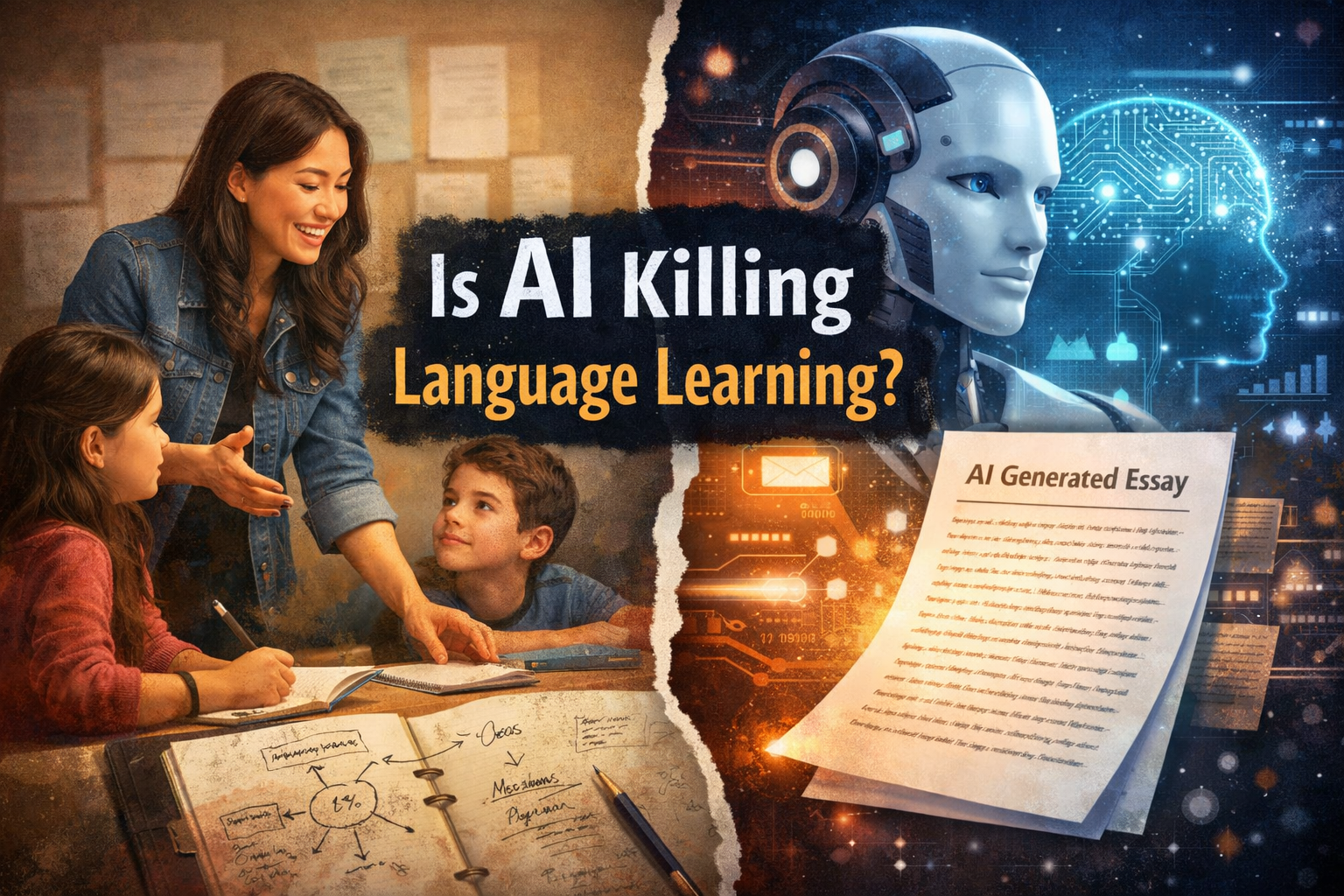
So, Is AI Killing Language Learning?
Not if you let it.
AI is power when used right.
It can be a tool for brainstorming, research, editing, coding, and exploration. But it should never replace the student’s original thought, voice, or creativity.
It is up to educators to show students the difference.
That is our responsibility now.
Not to fear AI.
Not to worship AI.
But to teach students how to use it with wisdom.
Because language learning is not dying.
It is simply asking more of us.
And if we rise to meet the moment, we will not create students who are dependent on tools. We will create students who are thoughtful, creative, self-aware, and prepared to use those tools better than anyone else.
That is the future. And that is the way.
Visit our award winning language school: http://www.motherlynotes.com
 Motherly Notes Methods - Nurture Love Educate